The Self-Storage Customer Portal: Must-Have Features in 2026
Customers in 2026 will not call you to pay a bill or request a unit change. The self-storage customer portal is now the front door, here is what it needs.
For a long time, the self-storage customer portal was an afterthought. Customers signed a lease in person, paid by check or autopay, and only contacted the office when something broke. The portal, if there was one, was a placeholder that showed the balance and let people update a card.
That world is gone. In 2026, the customer expects to do everything online, twenty-four hours a day, on the device that's already in their hand. The portal isn't a convenience feature anymore. It's the front door of the business. Operators who treat it as a checkbox lose customers to operators who treat it as a product.
What the portal has to do in 2026
There's a baseline set of features that every modern self-storage portal must support. Missing any one of these is a leak.
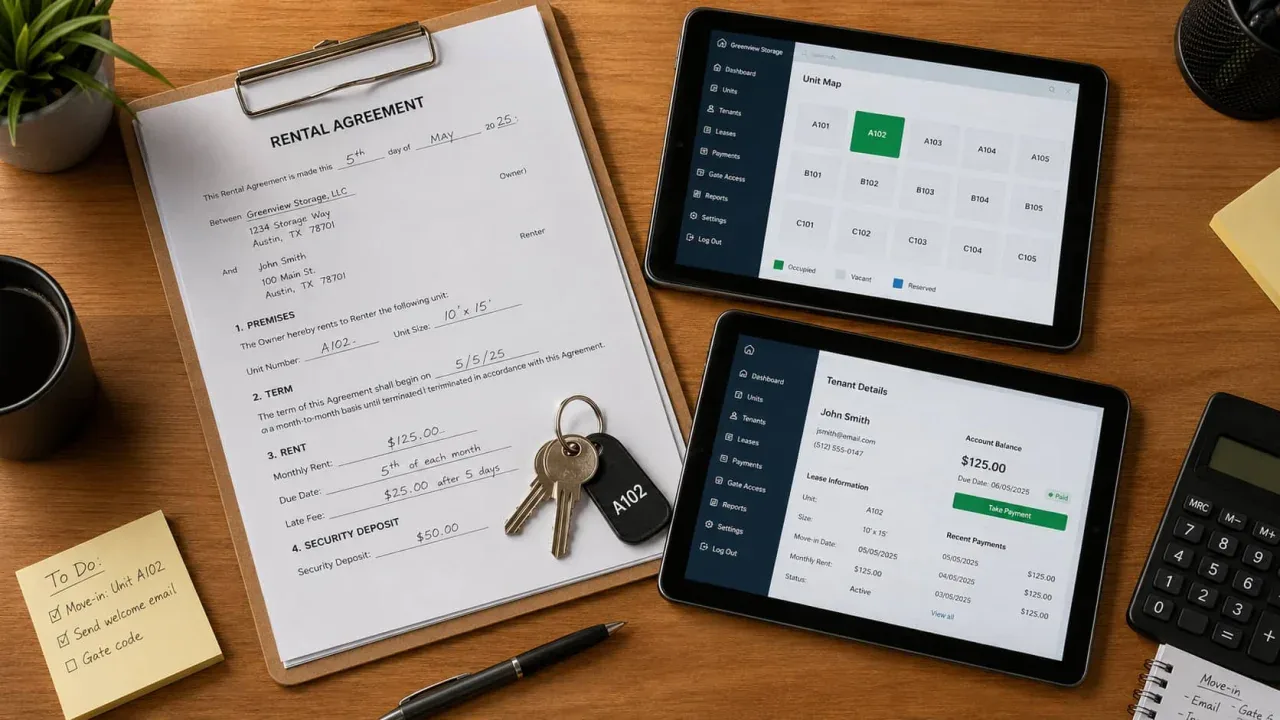
- Online rental and reservation. A prospect can browse available units, see real prices, reserve, sign, pay, and get a gate code without speaking to anyone.
- Autopay enrollment and card-on-file management. Customers add, update, and replace payment methods themselves. They can opt into autopay during signup or any time after.
- Invoice history and download. Every invoice, every payment, every refund, available as a PDF, for at least the last twenty-four months.
- Unit transfer and add-on requests. Customer needs a bigger unit, or wants to add a second one. The request flows through the portal, the office approves it, the system handles the prorate.
- Move-out request. Customer initiates the move-out with a target date, the system calculates the final invoice, and the office confirms.
- Documents. Lease, insurance certificate, any addenda, all accessible without an email request.
If your portal does all six of these well, you've cleared the bar. Most don't.
What separates a portal from a great portal
The features above are table stakes. The features that build retention are subtler and almost always missed by legacy software.
Self-service gate access management. Customers should be able to share their gate code with a trusted helper for a defined window, then revoke it. Asking the office to do this every time is a friction point that customers remember.
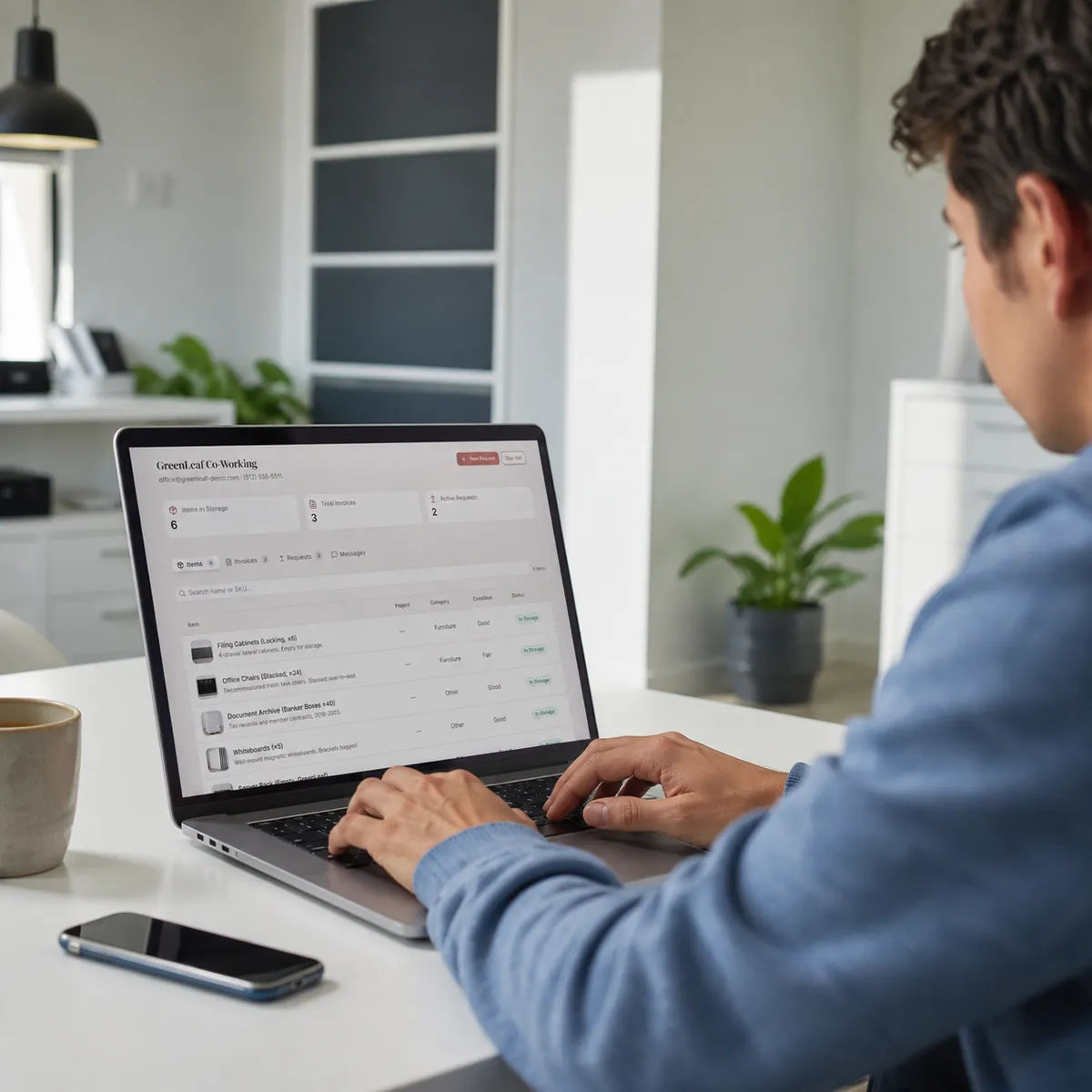
Item-level inventory for valet customers. If your facility offers any kind of valet or pickup service, the portal must show photos and a list of what's stored. This is the single feature that transforms storage from a real-estate purchase into an ongoing service relationship.
In-portal service requests. Pickups, deliveries, repacks, photography requests, all initiated from the portal with a price quoted up front and a confirmation when scheduled. No phone calls, no email back-and-forth.
Real notifications. Push or SMS notifications when a payment processes, when a service request is scheduled, when a gate code is used, when the facility is closing early. Email-only is 2015 thinking; in 2026, customers expect their phone to tell them.
What a portal should never do
A few patterns reliably push customers away:
- Force a separate mobile app download. The portal must work in a browser on a phone. App-only is friction nobody asked for.
- Require a password reset that involves a phone call to the office.
- Show information that's stale by hours. If a payment processed at 9am, the portal should show it at 9:01am.
- Surface internal jargon ("lien status," "unit class C") instead of plain language.
- Time out aggressively. Storage customers might log in once a month; making them re-authenticate every visit is unnecessary friction.
Each of these is a small thing in isolation. Together they make the portal feel like a chore, and the customer's mental model becomes "I have to deal with my storage facility today" instead of "I have storage."
How the portal earns its keep
A working portal pays for itself in four measurable ways: lower payment-related calls, faster collections on overdue accounts (because customers can pay themselves at 2am), higher conversion on new rentals (because the friction is gone), and lower churn (because the relationship feels modern).
Operators who upgrade a stale portal to a modern one routinely report a 20-30% drop in routine office calls within ninety days. The staff capacity that frees up goes into running the facility better, not staffing a help desk.
Branding and the multi-facility question
For independent operators, the portal should carry your brand, not the software vendor's. Customers should land on your domain, see your logo, and never see a "powered by" footer that competes for attention. For multi-facility operators, the portal should let a customer with units at multiple locations see all of them in one view, with one login, and one consolidated bill if they want it.
Most self-storage and valet software on the market in 2026 can clear these bars. A handful still can't. The portal demo is the fastest way to tell which is which, so make the prospect log in as a sample customer in the first ten minutes and judge what you see. The customer will.